

 By
By Flanges play an important role in industrial piping systems by providing secure, detachable connections between pipes, valves, pumps and other equipment. While flanges are available in several designs and material grades, the manufacturing method can have a significant influence on their mechanical properties, dimensional consistency and suitability for different applications.
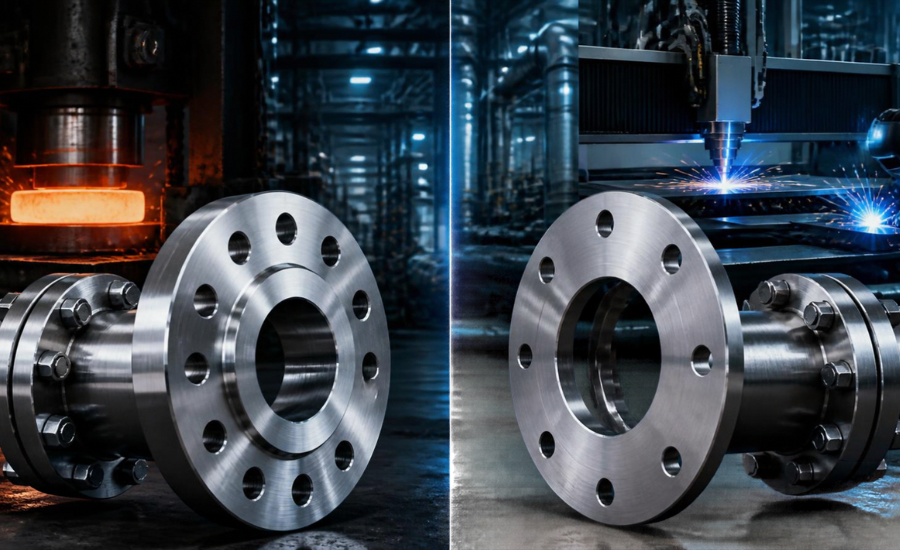
Two commonly used options are forged flanges and plate flanges. Although both can serve similar connection purposes, their manufacturing processes and performance characteristics are different. Understanding these differences can help engineers and procurement teams select the appropriate flange for a particular piping system.
What Are Forged Flanges?
Forged flanges are manufactured from metal billets or specially prepared raw material that is heated and shaped under controlled pressure. The forging process changes the grain structure of the material and produces a dense, strong component.
After forging, the flange may undergo processes such as heat treatment, machining, drilling and finishing to achieve the required dimensions and surface quality.
The controlled manufacturing process makes forged flanges suitable for applications where mechanical strength, pressure resistance and reliability are important considerations.
What Are Plate Flanges?
Plate flanges are generally manufactured by cutting or machining the flange from a metal plate. The plate is produced separately and then processed into the required flange dimensions, including the bolt holes and bore.
Depending on the material, specification and application, plate flanges can be produced efficiently in a range of sizes and thicknesses. Their manufacturing route can make them a practical option for certain lower-pressure or less demanding piping applications.
Manufacturing Process: Forged vs Plate
The key difference starts with how the raw material is converted into the finished flange.
Forged Flange Manufacturing
A typical forging process involves:
- Selecting the required material grade.
- Heating the billet to the appropriate forging temperature.
- Applying controlled mechanical force to shape the material.
- Performing heat treatment when required.
- Machining the flange to precise dimensions.
- Drilling bolt holes and machining the bore.
- Conducting inspection and testing according to the applicable specification.
The deformation involved in forging can help produce a refined and continuous grain flow, contributing to the component’s mechanical properties.
Plate Flange Manufacturing
Plate flanges generally follow a different route:
- A suitable metal plate is selected.
- The required flange shape is cut from the plate.
- The outside diameter and internal bore are machined.
- Bolt holes are drilled according to the required standard.
- Surface finishing and dimensional inspection are performed.
- Testing and certification are completed according to project requirements.
The simpler production route can be advantageous when large quantities or specific dimensions are required.
Performance Comparison
Strength and Load Resistance
Forged flanges are generally selected where higher mechanical strength and resistance to demanding loading conditions are required. The forging process produces a dense material structure and can provide favourable mechanical properties.
Plate flanges can also provide reliable service when correctly designed and manufactured, but their suitability depends heavily on material grade, thickness, design pressure and applicable standards.
Pressure Applications
For high-pressure piping systems, forged flanges are commonly considered because of their mechanical properties and manufacturing characteristics.
Plate flanges may be suitable for applications with less demanding pressure and temperature requirements. However, the final selection should always be based on engineering calculations and the applicable piping code rather than flange type alone.
Corrosion Resistance
Corrosion resistance primarily depends on the material grade, surface condition and operating environment rather than whether a flange is forged or cut from plate.
For example, stainless steel, Duplex and Super Duplex grades may be selected for applications involving corrosive fluids or challenging environments. Proper material selection is essential for achieving the expected service life.
Which Flange Should You Choose?
There is no single flange type that is suitable for every application. Engineers generally consider:
- Operating pressure and temperature
- Pipe size and wall thickness
- Material grade
- Fluid characteristics
- Corrosion conditions
- Applicable ASME, ASTM or other project standards
- Required testing and certification
- Installation and maintenance requirements
- Overall project cost
For demanding process, petrochemical, oil and gas or high-pressure applications, forged flanges may be specified where their mechanical characteristics provide the required performance.
For suitable applications where design conditions are less demanding, plate flanges can offer a practical manufacturing option.
Choosing an Experienced Manufacturer
The quality of the finished component depends not only on whether it is forged or plate-manufactured. Material traceability, dimensional accuracy, heat treatment, machining quality, inspection procedures and compliance with applicable standards are all important.
When evaluating forged fittings manufacturers in India, buyers should look beyond pricing and consider manufacturing capabilities, available material grades, quality-control procedures, testing facilities and documentation.
A reliable manufacturer should be able to provide relevant material test certificates and inspection documentation as required by the project specification.
Conclusion
Forged and plate flanges both have an important role in industrial piping systems, but their manufacturing processes and typical applications differ. Forged flanges are often considered for demanding applications where strength and pressure resistance are key requirements, while plate flanges can be appropriate for applications where their design and material specifications meet the required service conditions.
Ultimately, flange selection should be based on engineering requirements, material specifications, applicable standards and operating conditions. Working with an experienced manufacturer can also help ensure that the selected flanges meet the dimensional, mechanical and quality requirements of the project.